Best Free Text-to-Speech APIs for Developers (2026)
Compare the 7 best free text-to-speech APIs for developers in 2026—MusicGPT, ElevenLabs, Cartesia & more. Find the fastest, cheapest TTS for your stack.
Remember the 90s computer voice that sounded like a microwave? Absolutely flat and robotic.
But now that robotic voice sounding like a human is a reality with text-to-speech AI tools. With the market for the new computer voice (or the AI voice) anticipated to reach $34.52 billion in 2035, these TTS tools rewrite how quickly content gets made.
The multilingual podcast host, the anime character, and the Chinese voice—it's no longer just one voice; it’s thousands.
The ultimate question? Which text-to-speech API delivers a clear, natural, humane voice you can readily use in your content?
Let us help you find out. We tested 7 tools across:
- Latency (streaming vs async)
- Voice cloning quality
- Cost model (per char / per word / per minute)
- Language coverage
- Free tier for testing and practical usage
Best Free Text-to-Speech APIs: Full Breakdown
Tool | Key Feature | Best For | API Pricing |
MusicGPT TTS | 5,000+ voices, 140+ languages, 25+ audio tools | All-in-one creative audio | Pay-as-you-go |
ElevenLabs | Voice cloning, expressive & real-time TTS | Narration & dubbing | $6/mo |
OpenAI TTS | Real-time voice, WebSocket, 2 quality tiers | Voice agents | $8/mo |
Amazon Polly | 4 TTS engines, speech marks | AWS apps | Pay-as-you-go |
Google Cloud TTS | 380+ voices, 75+ languages, SSML | Multilingual & GCP apps | Pay-as-you-go |
Cartesia | <90ms latency, 42 languages | Real-time agents | $49/mo |
Inworld AI | ~120ms latency, emotion & SSML | Voice agents | $25/mo |
MusicGPT TTS API
Strength: Every major TTS API, including Google, ElevenLabs, and OpenAI, bills you per character, but the MusicGPT API bills you per 100 words, charging as low as $0.07 per 100 words on the pay-as-you-go plan with commercial rights.
This means before you give it an audiobook chapter, a product description, or an agent's reply, you can predict the costs already.
Getting started is easy, with every new user getting up to 10 free song generations on sign-up.
MusicGPT’s Text-to-Speech API is developer-first by design. You get to choose between four models per request to trade speed, quality, and cost on the fly. You also get webhook support for async pipelines and global CDN delivery with latency under 180ms.
About language coverage, it supports 5,000+ AI voices in 140+ languages, one of the widest breadths any competitor can offer at this pricing.
Interestingly, MusicGPT allows custom voice profile generation and voice cloning without any extra per-voice fees or gatekeeping.
The Advantage: This is not a voice-only shop. The same API that generates your narration also generates music, sound effects, stems, and voice changers. So if you’re developing a podcast with intro music, a game with SFX and dialogues, or an on-the-go voice generation tool, this unified stack is hard to beat.
Weakness: No advanced controls on voice creation. Detailed documentation with HIPAA BAA, SOC 2, and detailed SLAs related to enterprise compliance is still not published, which is fine for startups but not for regulated industries.
Verdict: If you want predictable billing and an ethical AI audio platform that handles voice, music, and sound effects under one roof, MusicGPT is a practical choice.
Eleven Labs TTS API
Strengths: If you A/B test TTS generation tools, you’ll know Eleven v3's prosody is one of the best for an AI TTS API to handle dramatic pauses and emotional shifts perfectly well.
But ElevenLabs gives you two completely different latency profiles depending on your work size.
Its faster model, FlashTurbo, drops latency to ~75 ms at half the price and loses some expressiveness at $0.05 per 1K characters.
But if you're looking to build TTS agents, you can use the v3 Conversational model at ~280 ms latency.
Flash v2.5 only supports 32 languages. v3 lets you generate 70+ languages, but it caps you at 5,000 characters per request vs. Flash's 40,000 characters.
Weakness: If you're generating long-form content daily, it's expensive, with the v3 model running at $0.10 per 1,000 characters. The free tier is only meant for testing with roughly 10 minutes a month and no commercial rights.
Verdict: If the voice is your product with audiobooks, high-end video narration, and branded audio content, this is where you can spend your money.
OpenAI TTS API
Strength: OpenAI offers you three models here:
TTS-1 at $15 per million characters. This one is quick, cheap, and fine for notifications and chatbots.
TTS-1-HD at $30/1M doubles the fidelity for when you need cleaner consonants on podcasts or IVR greetings.
Then there's gpt-4o-mini-TTS, the interesting one, which charges you at ~$0.015/min, including 13 AI voices with natural-language instructions for genuine character work.
Weakness: The built-in voice library is small (9 voices on the legacy models, 13 on mini-TTS), and while OpenAI technically offers custom voice cloning now, it's gated and requires a consent recording with up to 20 voices per org.
In fact, OpenAI's TTS API effectively has no free tier. You get a one-time trial credit on a new OpenAI account for $5 to try it.
Also, the 4,096-character limit on tts-1/HD restricts your long-form content, and mini-tts drops that to 2,000 tokens.
Verdict: If you're building voice agents and chatbots, you can use the GPT stack. But this might not work for premium audio work.
Amazon Polly TTS API
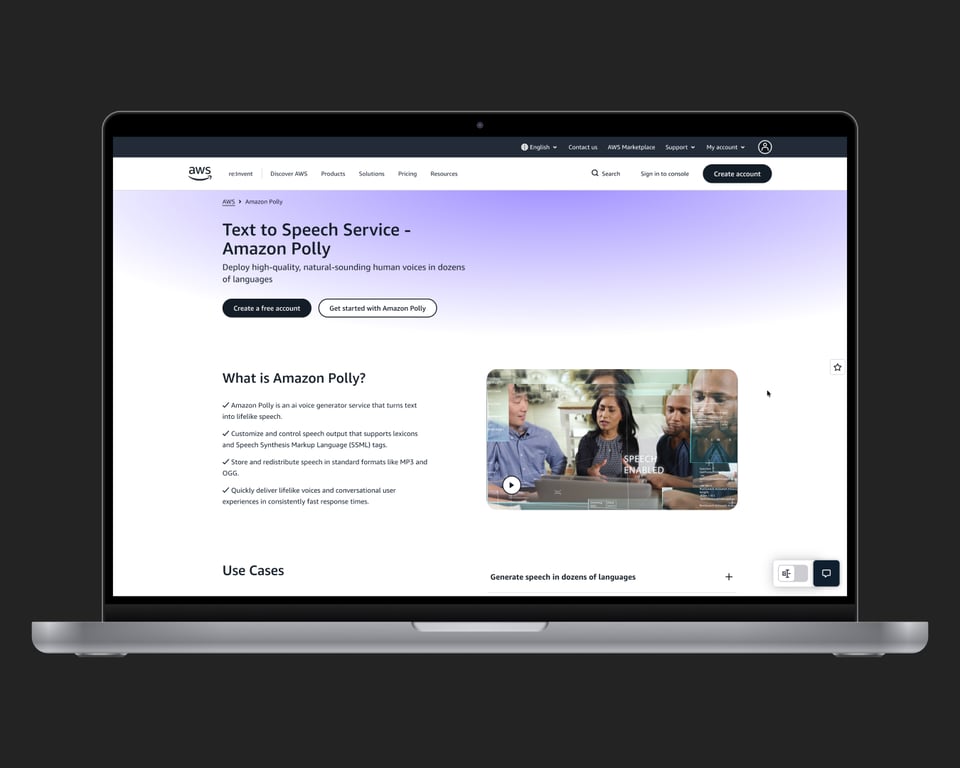
Strength: Amazon Polly is one of the cheapest ways to generate text-to-speech. It gives you four engines starting at $4 per million characters.
And the free tier is the most generous we tested; it gives you about 5 million standard characters and adds 1 million neural characters per month for your first 12 months for free.
Polly is also the most controllable API here, with full SSML, speech marks with viseme data for lip-sync, custom lexicons to fix your brand name's pronunciation forever, and free unlimited caching and replay.
Its language coverage is spectacular, supporting 60+ voices across 25+ languages and variants.
Weakness: You can get a custom "brand voice" here, but otherwise, no voice cloning exists. Even the generative voices can give pleasant voices that can read but can't act.
Also, the sync API caps you at 3,000 billable characters per request, so long-form goes through the async task route instead.
Verdict: If you need audio only for IVR systems, interactive assistants with AWS synergy, Polly is the pick. But you can’t use it for long-form content audio.
Google Cloud TTS API
Strength: Google is practically generous. Cloud TTS offers a permanent free tier without any 12-month countdown or credit expiry, with 4M standard characters, 1M WaveNet, 1M Neural2, and 1M Chirp 3 characters every month. On top of it? $300 in credit for new accounts.
If you’re a bootstrapped startup, an indie developer, or building an early-stage product, you might be looking for this.
It further supports bidirectional streaming for real-time voice agents, so your work gets quicker. It carries one of the widest catalogs in the game, with about 300+ voices across 40+ languages.
Weakness: Control is equally expansive, but it comes with a major setback. Although you get full SSML support, audio profiles for telephony, and even spoken date/time formatting, it requires about 30-60 minutes of setup time to create a GCP project. Plus, its pricing page has seven tiers, which reads more like a tax form; you literally spend longer decoding the costs than generating the audio.
Voice cloning is not only limited but also expensive, starting at $60 per million characters. You can generate up to 50 custom voices per project with consent.
Verdict: Maximum control, maximum free tier, maximum setup friction. Bring your patience.
Cartesia TTS API
Strength: Cartesia is refreshingly modern because this TTS API lets you generate audio in under five minutes. With its free tier, you get $10 in credit on signup, and afterwards it charges you based on a pay-as-you-go model.
Talking about controls, you don't get full SSML, but you can optimize speed, emotion/style tags, voice mixing and blending, and guide pronunciation handling without technical gymnastics. No doubt, it's a developer's API designed for people who hate onboarding friction.
Latency is Cartesia's superpower, as its Flash model delivers audio in roughly 40–75 milliseconds, with WebSocket streaming designed for real-time voice agents and phone calls.
Language coverage recently hit 72 languages on the Flash model, up from a more limited catalog a year ago, with a genuine global reach.
Weakness: You can clone your voice with Cartesia, but with a 20-clone limit per account. Like OpenAI and Google Cloud TTS, it does require consent. If you're producing long-form audio content, this is more expensive at $0.06/min, and that too when competitors can deliver richer expressiveness.
Verdict: Great for real-time voice agents with strong latency and frictionless setup, but not built for long-form or enterprise-scale work.
Inworld AI TTS API
Strength: Inworld is quite simple to start; just integrate one of their SDKs into your workflow, and you're generating character voices in minutes.
Coming to the free tier, it only allows you to test roughly 70 minutes of TTS on signup.
Its controls are aimed more at game and character work with natural-language voice direction, inline non-verbal cues like [laugh] or [sigh], and stability modes.
Inworld offers genuinely elite latency with <100ms streaming, designed for live NPCs and interactive dialogue that generates about 200+ languages.
Zero-shot cloning is free for all users from just 5–15 seconds of audio, though remember, cloning might be free, but generation isn't.
Weakness: No permanent free tier. Per-character pricing (~$25–35/1M on demand) runs expensive for long-form audio. Voice count and narration expressiveness lag dedicated TTS platforms; this engine is tuned for dialogue, not audiobooks. Outside gaming, the ecosystem is thinner.
Verdict: A strong pick for games and interactive characters but not built for long-form narration or cost-sensitive TTS work.
Which TTS API Should You Choose?
Building real-time voice agents? Go for Cartesia or Inworld for faster speed, and ElevenLabs Flash if you need more expressiveness.
Want premium narration? Try ElevenLabs v3 with best-in-class prosody and cloning.
Google Cloud TTS and Amazon Polly win on budget and free-tier longevity.
Best overall developer value? Choose MusicGPT TTS API, the only platform that bills per 100 words and offers voice, music, and SFX in one API.
So, stop counting characters and try your first voice feature today.
 Made with Bullet